
Stay in the Loop Where Mistakes Get Expensive
- #artificial-intelligence
- ·#software

TL;DR
Most of the build loop for Mark runs without me. Automations move tickets along. AI agents take the first pass at grooming, then do the build: development, testing, and review. I stay in it at three points: finishing the grooming before the build starts, when a product decision comes up, and when there's a finished page to look at. The rule I use is simple. Automate the steps that are cheap to redo. Stay in the steps where a mistake costs real rework, or where only you know the answer.
Most of the loop runs without me
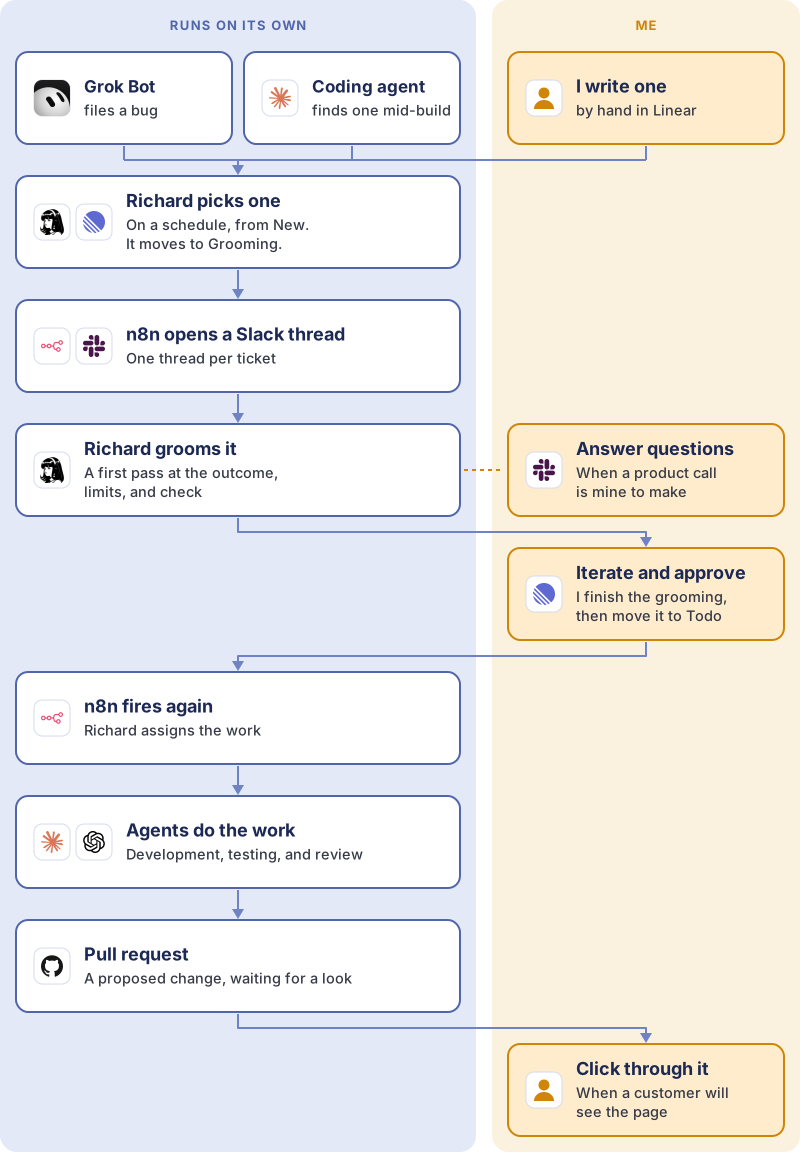
Mark's work lives as tickets in Linear, and they come from all over. I write some by hand. Grok Bot files some from bug reports. A coding agent logs some when it finds something mid-build that's outside its ticket. They all land in the same pile of new tickets.
An AI orchestrator called Richard works that pile. He's a profile in Hermes, an agent runtime I run on my own machine. On a schedule, he looks through the new tickets, picks one to groom, and moves it to Grooming. That status change fires n8n (an automation tool that connects apps), which opens a Slack thread for the ticket. I can also kick off grooming by hand with a label.
In that thread, Richard takes the first pass at grooming: the outcome, the limits, and how we'll check it. Once I approve the ticket, he hands it to coding agents, usually Claude Code. They handle the development, the testing, and the review, and the result comes back as a pull request: a proposed change, waiting for a look.
I don't write the code, and I don't shepherd tickets from step to step.
Where I stay in it
Finishing the grooming. Richard's grooming is a first draft. I iterate on it in the thread until the outcome, limits, and check are right, and then I approve it by moving the ticket to Todo. That move is what tells the agents to start building. A ticket can read clearly and still be only almost clear. If an agent builds on that, I find out at the end and throw the work away. Polishing it first costs me a few minutes.
When a decision is mine to make. If grooming or coding hits a product question, Richard tags me in the same Slack thread and marks the ticket as needing input. Agents are good at filling gaps. They're bad at knowing which gaps they shouldn't fill. The question waits for me, and the answer stays with the ticket.
When there's something to look at. Passing tests can sit on a page that's wrong. When a change is something a customer will see, I click through it the way they would.
Everything else, I leave alone.
How to pick the spots
For each step in a job, I ask three questions.
- If this step goes wrong, how much work gets thrown away? A bad draft is cheap to redo. A week of building on the wrong idea isn't. Put a person where the cost jumps.
- Does it need a call only you can make? Pricing, tone with a specific client, what the product should do. An agent can ask. It shouldn't guess.
- Can a machine check it? If tests, totals, or a checklist can catch the mistake, let them. Save your attention for what they can't catch.
The trap runs both ways. Hand everything to the agents and you'll eventually review a finished job built on a wrong assumption. Stay in every step and you're the bottleneck, and the automation saves you nothing. The goal is a few human steps that are short and land where they matter.
Try it on one job
Pick one job that repeats every week. Write down the steps. Then mark each one: who does it, and whether a mistake there is cheap or expensive.
Take a weekly client note. An assistant can pull the numbers and draft it. A simple check can match the totals to your tracker. You read it before it goes out, because that's the step where a wrong sentence reaches a client.
The check should be something you can run without redoing the job. If most of your AI use is talking to a general assistant, that conversation sits in front of a loop like this one. And writing the trigger, the human step, and the check is plain loop engineering.
If you've mapped a job and want a second reader on where you should stay in it, that's a 20-minute conversation. We look at the recurring job and the tools you already use. I'll tell you if AI won't help. Simple conversation. No pitch, no commitment.
If you can't write the steps down yet, skip the call. Start there.
Book a discovery call👋 Good read?
Subscribe for more insights on AI, data, and software.